
Exterior paint is protection first.
Weatherboard, render, brick and fibre cement across Melbourne — prepared to the substrate and applied inside the conditions the product actually specifies.
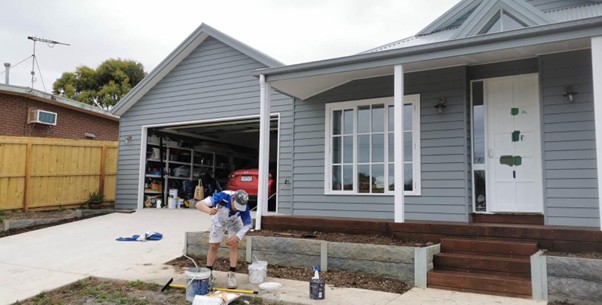 Exterior painting · Melbourne
Exterior Painting Melbourne – Protection That Happens to Look Good
The colour is the part you notice. The job the coating is actually doing is keeping water, UV and movement away from the material underneath.
That is why exterior work is decided by two things a colour chart will not tell you: what your house is made of, and what the weather is doing while the coat dries.
The substrate decides the job
Two houses of the same size can be very different jobs. What yours is clad in changes the preparation, the products and the time.
- Weatherboard — the most labour-intensive. Every board has two edges, and prep is where the hours go
- Render and cement sheet — cracking and previous patch repairs are the things to get right
- Brick veneer — often trim, fascia, eaves and gutters only, which is a much smaller job
- Fibre cement — common on eaves and soffits, and on pre-1990 homes it needs identifying before anyone touches it
- Heritage Victorian and Edwardian — detailed timberwork, and usually old paint that has to be handled carefully
Two storeys adds access, and access adds cost that has nothing to do with paint.
The Melbourne weather window is real
Exterior coatings have application limits printed on the datasheet, and they are not suggestions. Dulux Weathershield, for example, says not to apply below 10°C — or when the temperature may fall below 10°C during the drying period.
Melbourne’s mean minimum temperature in June, July and August sits below that floor. Mean 9am humidity peaks around 80% in June, against a ceiling of roughly 85% on many protective coatings. And August, September and October carry the most rain days of the year.
So we will tell you honestly if an exterior job should wait for the season. Here is the data behind that.
Preparation outside
Outside, prep is not cosmetic — it is the difference between a coating that protects for a decade and one that peels in two years.
- Clean down: dirt, chalking, mould and lichen removed, and the surface left to dry properly
- Failed paint cut back to a sound edge and feathered
- Timber repairs — rot, splits and checked boards dealt with, because paint does not fix timber
- Rust cut back and treated before coating, so it is stopped rather than painted over
- Gaps and joins sealed where water would otherwise get behind the coating
- Bare and repaired areas primed and sealed to the right product
High-pressure water is not appropriate on every substrate, and on pre-1990 material it can be genuinely dangerous.
Older homes: what must not happen
Asbestos Victoria’s guidance is unqualified on this — asbestos cement must never be water-blasted or dry-sanded in preparation for painting, coating or sealing. Pre-1970 paint may contain lead, and dry sanding or open-flame stripping is off the table there too.
On any older Melbourne home we work out what is actually there before quoting a method, and we will say so if a job needs a licensed specialist rather than a painter.
A cheap exterior quote is usually cheap because the preparation was left out. Prep is the part you cannot see, and the part that decides whether the coating is still sound in eight years.
Rust, mould and the surfaces Melbourne is hard on
Bayside and coastal suburbs are a more corrosive environment than inland ones, and that changes the coating system rather than just the colour. Australian standards exist specifically to classify atmospheric corrosivity and select protective coatings accordingly — which is a long way of saying the right system for a Brighton fence is not automatically the right system for one in Tarneit.
Shaded, south-facing walls are where mould keeps returning. Mould-resistant coatings help resist it. Nothing prevents it outright, and any painter who says otherwise is selling.
Eaves, gutters, fascia and the bits people forget
A repaint that stops at the walls looks unfinished from the street and leaves the most exposed timber unprotected.
- Eaves and soffits
- Fascia boards and barge boards
- Gutters and downpipes
- Window frames, sills and door frames
- Garage doors, carports and outbuildings
- Verandah posts, railings and decking trim
These are quoted line by line so you can include or exclude them with your eyes open.
What you get in writing
Before anything starts:
- The surfaces included, and the ones that are not
- The preparation included, named specifically
- The products, the system and the number of coats
- How access is being handled, including any scaffold
- The expected working days, and how weather delays are handled
- The price, and whether GST is in or out
Our painting work carries a five-year workmanship warranty. Eligibility, inclusions and exclusions are confirmed in the written project quotation.
Protect it properly, while the weather allows.
Tell us what your house is clad in and we will come and look at the condition.
South Yarra · Richmond · Port Melbourne · Albert Park · Camberwell · Hawthorn · Kew · Tarneit · Truganina · Werribee